FAMOUS AUTHORS

  • Home
  • Blog
  • Free Audio Books
  • Famous Inventors
  • Suggest
  • Contact

W. H. Auden

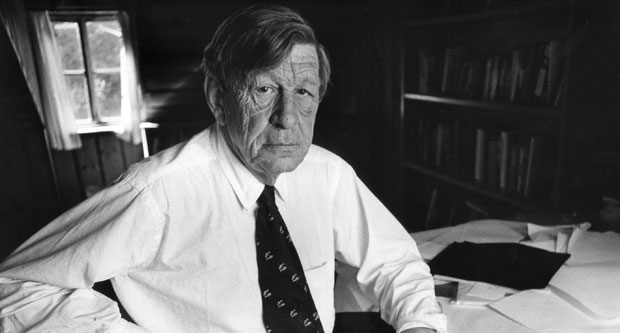
W. H. Auden Photo

Barbara Everett, fascinated with W. H. Auden, wrote a book, Auden, to celebrate the poet. She pays him high tribute with her words:

“In his verse, Auden can argue, reflect, joke, gossip, sing, analyze, lecture, hector, and simply talk; he can sound, at will, like a psychologist on a political platform, like a theologian at a party, or like a geologist in love; he can give dignity and authority to nonsensical theories, and make newspaper headlines sound both true and melodious.”

 Other notable writers and critics have described his work as ‘musical’ and have commented that his poems sound ‘sounds impressive’. They have marveled at his linguistic innovation and described it as ‘Audenesque’ that has helped modernize English to adapt to contemporary ideas and notions.

James Fenton, on the other hand, was not so enamored with W. H. Auden’s continued truncation of the English language. Fenton writes in the New Statesman:

“For years—for over forty years—the technical experimentation started by Auden enlarged and enriched the scope of English verse. He rediscovered and invented more than any other modern poet. . . . And yet there grew up . . . a number of mannerisms, such as the use of nouns as verbs, or the employment of embarrassingly outdated slang, or the ransacking of the OED [Oxford English Dictionary], which became in the end a hindrance to his work.”

 What is obvious from his works is that Auden was a person of his times and often seemed to change his stance to keep up with the prevailing trendy notions. But most critics regard this as only the undeserved criticism of his rivals. Auden has been eulogized at two extremes; Hugh MacDiarmid, labeled him “a complete wash-out”. On the other end of the spectrum, The Times (London), in its obituary of Auden, describes him as: “W. H. Auden, for long the enfant terrible of English poetry . . . emerges as its undisputed master.”

Auden’s life makes interesting reading. His father was an accomplished physician and academic. Education was an important aspect of the family values and Auden too was well-educated. Science fascinated him, and so he took on engineering science as his professional studies. However, he realized that though science fascinated him, it was language and the science of words that he was passionate about and switched his course to English Language studies. On graduating, he spent a year living in Berlin but then returned and took up a position as a teacher.

Auden sometimes shocked society with his actions. He believed: “….. We are all here on earth to help others; what on earth the others are here for I don’t know.” It was this strong belief that made him take a rather major decision. He married, in 1935, Erika Mann, the daughter of German writer Thomas Mann so that she could obtain British citizenship. It was clearly not a match made in heaven and was rather a marriage of convenience because Auden was not the ‘marrying kind’; he was homosexual.

The inter-war years – the period between the two world wars, began with immense merrymaking and expression of joy because the war was finally over. However, the headiness was short-lived because the world soon went into a tailspin with the Wall Street crash; the depression years had begun. This period is aptly named by W. H. Auden as ‘The Age of Anxiety’. The world witnessed the rise of fascism, the waning romance with Marxism and then finally the Spanish Civil War.

Liberal writers and thinkers of the era, all went off to Spain to witness at first hand the events of the conflict. Auden too, was amongst them. The German intrusion in Guernica shocked them all. They woke up to the realization that all was not right with the world;  and that it was only a question of time before another global conflict developed.

Around this time Auden emigrated to the USA, where he met Chester Kallman, who would remain Auden’s companion for life. Auden was reviled for ‘deserting Britain’ on the eve of the war, but his escape to the USA gained him instant reward. He wrote and published his poems ‘The Age of Anxiety’, which won him the highly coveted Pulitzer Prize.

Buy Books by W. H. Auden

Google
Custom Search

Famous Authors

  • John Updike
  • Jonathan Safran Foer
  • Jonathan Swift
  • Jorge Luis Borges
  • José Saramago
  • Joseph Conrad
  • Joseph Heller
  • Jostein Gaarder
  • Joyce Carol Oates
  • Juan Rulfo
  • Jules Verne
  • Julian Barnes
  • Karl May
  • Kazuo Ishiguro
  • Ken Follett
  • Khaled Hosseini
  • Khalil Gibran
  • Knut Hamsun
  • Kurt Vonnegut
  • Laura Ingalls Wilder
  • Lee Child
  • Leo Tolstoy
  • Lewis Carroll
  • Lord Byron
  • Louise Hay
  • Malcolm Gladwell
  • Marcel Proust
  • Margaret Mitchell
  • Margaret Peterson Haddix
  • Marguerite Yourcenar
  • Mario Puzo
  • Mario Vargas Llosa
  • Mark Twain
  • Martin Amis
  • Mary Higgins Clark
  • Mary Shelley
  • Maurice Sendak
  • Maya Angelou
  • Michael Crichton
  • Michel De Montaigne
  • Michel Houellebecq
  • Miguel De Cervantes
  • Mitch Albom
  • Napoleon Hill
  • Neil Gaiman
  • Niall Ferguson
  • Nicholas Sparks
  • Nick Hornby
  • Nicole Krauss
  • Nora Roberts
  • Norman Mailer
  • Oscar Wilde
  • Ovid
  • P. D. James
  • Patricia Cornwell
  • Paul Auster
  • Paul Celan
  • Paul Valéry
  • Paulo Coelho
  • Peter Hitchens
  • Philip Pullman
  • Pierre Dukan
  • R. L. Stine
  • Ralph Ellison
  • Raymond Carver
  • Raymond Chandler
  • Raymond E. Feist
  • Rhonda Byrne
  • Richard Bach
  • Richard Scarry
  • Richard Wright
  • Rick Riordan
  • Rick Warren
  • Roald Dahl
  • Robert Jordan
  • Robert Louis Stevenson
  • Robert Ludlum
  • Robert Munsch
  • Robin Cook
  • Roger Hargreaves
  • Rudyard Kipling
  • Rumi
  • S. E. Hinton
  • Salman Rushdie
  • Samuel Beckett
  • Samuel Johnson
  • Seamus Heaney
  • Shaun Tan
  • Sidney Sheldon
  • Simone de Beauvoir
  • Sophocles
  • Stendhal
  • Stephen Hawking
  • Stephen King
  • Stephenie Meyer
  • Stieg Larsson
  • Suzanne Collins
  • Sylvia Plath
  • Ted Hughes
  • Tennessee Williams
  • Terry Brooks
  • Terry Pratchett
  • Thomas Mann
  • Thomas Pynchon
  • Tom Clancy
  • Tom Robbins
  • Toni Morrison
  • Truman Capote
  • Umberto Eco
  • Viktor Frankl
  • Virgil
  • Virginia Woolf
  • Vladimir Nabokov
  • Walt Whitman
  • Wilbur Smith
  • William Blake
  • William Faulkner
  • William Gibson
  • William Golding
  • William S. Burroughs
  • William Shakespeare
  • Zora Neale Hurston

Famous Authors

  • Agatha Christie
  • Alan Moore
  • Albert Camus
  • Aldous Huxley
  • Alexander Mccall Smith
  • Allen Ginsberg
  • Anaïs Nin
  • Anne Frank
  • Anne Rice
  • Antoine De Saint-Exupéry
  • Anton Chekhov
  • Arthur C. Clarke
  • Arthur Miller
  • Arundhati Roy
  • Astrid Lindgren
  • Ayn Rand
  • Barbara Cartland
  • Beatrix Potter
  • Beverly Cleary
  • Brian Jacques
  • C. S. Lewis
  • Carol Ann Duffy
  • Charles Dickens
  • Chinua Achebe
  • Christopher Hitchens
  • Christopher Marlowe
  • Christopher Paolini
  • Chuck Palahniuk
  • Clive Cussler
  • Cometan
  • Cormac McCarthy
  • Czesław Miłosz
  • D.H. Lawrence
  • Dale Carnegie
  • Dan Brown
  • Danielle Steel
  • Dante Alighieri
  • Daphne du Maurier
  • Dashiell Hammett
  • Dav Pilkey
  • David Baldacci
  • David Foster Wallace
  • David Sedaris
  • Dean Koontz
  • Debbie Macomber
  • Denis Diderot
  • Don DeLillo
  • Doris Lessing
  • Douglas Adams
  • Dr. Seuss
  • E.M. Forster
  • Edgar Allan Poe
  • Edith Wharton
  • Elbert Hubbard
  • Elie Wiesel
  • Ellen G. White
  • Émile Zola
  • Emily Dickinson
  • Enid Blyton
  • Eoin Colfer
  • Eric Carle
  • Erica Jong
  • Ernest Hemingway
  • Euripides
  • F. Scott Fitzgerald
  • Fernando Pessoa
  • Frank McCourt
  • Flannery O’Connor
  • Franz Kafka
  • Gabriel García Márquez
  • Geoffrey Chaucer
  • George Bernard Shaw
  • George Eliot
  • George Orwell
  • George R. R. Martin
  • Germaine Greer
  • Gertrude Stein
  • Giacomo Leopardi
  • Giovanni Boccaccio
  • Günter Grass
  • Gustave Flaubert
  • H. G. Wells
  • Hans Christian Andersen
  • Harper Lee
  • Haruki Murakami
  • Henning Mankell
  • Henrik Ibsen
  • Henry David Thoreau
  • Henry James
  • Henry Miller
  • Herman Melville
  • Hermann Hesse
  • Homer
  • Honoré De Balzac
  • Hunter S. Thompson
  • Ian Fleming
  • Ian McEwan
  • Isaac Asimov
  • Isabel Allende
  • Italo Calvino
  • Italo Svevo
  • J. G. Ballard
  • J. K. Rowling
  • J. R. R. Tolkien
  • J.D. Salinger
  • Jack Kerouac
  • Jack London
  • Jackie Collins
  • Jacqueline Wilson
  • James Frey
  • James Joyce
  • James Patterson
  • Jane Austen
  • Jean M. Auel
  • Jeff Kinney
  • Jeffrey Archer
  • Jo Nesbø
  • Johann Wolfgang Von Goethe
  • John Gray
  • John Grisham
  • John Irving
  • John Keats
  • John Milton
  • John Steinbeck

Recent Posts

  • 10 Famous Russian Authors You Must Read
  • 10 Famous Indian Authors You Must Read
  • 10 Famous Canadian Authors You Must Read
  • Top 10 Christian Authors You Must Read
  • 10 Best Graphic Novels Of All Time
  • 10 Best Adult Coloring Books Of All Time
  • 10 Best Adventure Books of All Time

Cont.

  • 10 Best Mystery Books of All Time
  • 10 Best Science Fiction Books Of All Time
  • 12 Best Nonfiction Books of All Times
  • Top 10 Greatest Romance Authors of All Time
  • 10 Famous Science Fiction Authors You Must Be Reading
  • Top 10 Famous Romance Novels of All Time

Cont.

  • 10 Famous Science Fiction Authors You Must Be Reading
  • Top 10 Famous Romance Novels of All Time
  • 10 Best Children’s Books of All Time
  • 10 Influential Black Authors You Should Read
  • 16 Stimulating WorkPlaces of Famous Authors
  • The Joy of Books

Copyright © 2026 FamousAuthors.org