FAMOUS AUTHORS

  • Home
  • Blog
  • Free Audio Books
  • Famous Inventors
  • Suggest
  • Contact

Niccolò Machiavelli

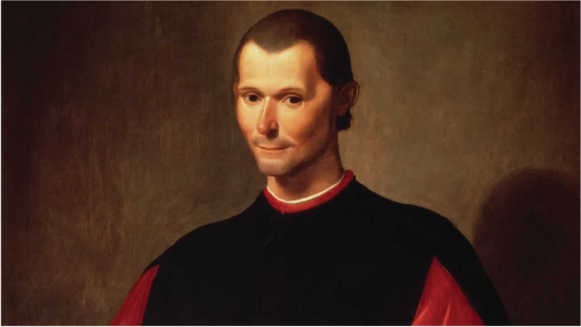
Niccolò Machiavelli Photo

Early sixteenth century Italian political and literary figure, Niccolò Machiavelli, was the pioneer of the modern political theory. Inspired by his masterpiece, The Prince, the term “Machiavellian” was coined to describe the use of unscrupulous methods to achieve diabolical ends as endorsed by Machiavelli in the book.

On May 3, 1469, in Florence, Italy, Niccolò di Bernardo dei Machiavelli was born during the period of great political upheaval. Italy was divided into four city-states where popes had waged war in acquisition of power. In fact the other European states had set their eyes on Italy with the same intention. At the age of 29, Machiavelli first stepped into a government position, shortly after Savonarola’s execution. Notwithstanding his lack of administrative background, he was appointed the second chancellor of the Florentine Republic. His position required him to produce official Florentine government documents. The reason he was elected for this powerful diplomatic post was because of his educational background. During the late fifteenth century, humanism was at rise and the Italian humanists underlined the significance of classical studies. Machiavelli, having expertise in ancient history, moral philosophies, classical studies and Latin, was deemed perfect candidate for the position.

Being a diplomat, Machiavelli was required to strengthen the foreign and diplomatic relations of the Republic. For that purpose he travelled across Europe observing the rise and fall of regimes and their leadership. These observations he made while serving as a diplomat and ambassador developed his insight of the effective methods of sustaining leadership. His later works substantiate the fact that a wide portion of his political philosophy was fundamentally based on the impact of the sociopolitical climate of his time. For over a decade, he served as a diplomat during the temporary downfall of the Medici family. During this time, he earned a scandalous reputation for his blatant acts. He was caught devising a plan against the return of the Medici family. Thereafter, he was banished from any active role in political affairs after being tortured and jailed.

The time followed his political inactivity was a dark chapter in his life. However, he utilized the time reading Roman history and the insight he gained resulted in the magnum opus, titled The Prince. It is considered a highly influential and equally scandalous political handbook. The central theme of the book is the willpower versus fate. According to Machiavelli, man controls his own fate which dictates one to gain power by resorting to any means possible regardless of the depravity it entails. Critics are divided on the subject whether the eponymous character is inspired by the notorious Cesare Borgia, or the book was merely a satire. It was openly condemned by Pope Clement VIII for endorsing the exercise of fear and deception to rule a kingdom.

In addition to that, Machiavelli penned numerous satirical plays, poems, biographies and political treatises. Some of his works include a biography, Life of Castruccio Castracani, a play, Mandragola, a historical treatise, The History of Florence and a political treatise On the Art of War (1521). His political treatise, Discourses on Livy, sheds light on his diplomatic experiences and political observations he made from historical events about the rules of statecraft. Despite his ultimate wish to resume his political career, it was never granted. Died in 1527, Niccolò Machiavelli was interred in his tomb in the church of Santa Croce, the place where he was banned from entering in his final years.

Buy Books by Niccolò Machiavelli


Google
Custom Search

Famous Authors

  • John Updike
  • Jonathan Safran Foer
  • Jonathan Swift
  • Jorge Luis Borges
  • José Saramago
  • Joseph Conrad
  • Joseph Heller
  • Jostein Gaarder
  • Joyce Carol Oates
  • Juan Rulfo
  • Jules Verne
  • Julian Barnes
  • Karl May
  • Kazuo Ishiguro
  • Ken Follett
  • Khaled Hosseini
  • Khalil Gibran
  • Knut Hamsun
  • Kurt Vonnegut
  • Laura Ingalls Wilder
  • Lee Child
  • Leo Tolstoy
  • Lewis Carroll
  • Lord Byron
  • Louise Hay
  • Malcolm Gladwell
  • Marcel Proust
  • Margaret Mitchell
  • Margaret Peterson Haddix
  • Marguerite Yourcenar
  • Mario Puzo
  • Mario Vargas Llosa
  • Mark Twain
  • Martin Amis
  • Mary Higgins Clark
  • Mary Shelley
  • Maurice Sendak
  • Maya Angelou
  • Michael Crichton
  • Michel De Montaigne
  • Michel Houellebecq
  • Miguel De Cervantes
  • Mitch Albom
  • Napoleon Hill
  • Neil Gaiman
  • Niall Ferguson
  • Nicholas Sparks
  • Nick Hornby
  • Nicole Krauss
  • Nora Roberts
  • Norman Mailer
  • Oscar Wilde
  • Ovid
  • P. D. James
  • Patricia Cornwell
  • Paul Auster
  • Paul Celan
  • Paul Valéry
  • Paulo Coelho
  • Peter Hitchens
  • Philip Pullman
  • Pierre Dukan
  • R. L. Stine
  • Ralph Ellison
  • Raymond Carver
  • Raymond Chandler
  • Raymond E. Feist
  • Rhonda Byrne
  • Richard Bach
  • Richard Scarry
  • Richard Wright
  • Rick Riordan
  • Rick Warren
  • Roald Dahl
  • Robert Jordan
  • Robert Louis Stevenson
  • Robert Ludlum
  • Robert Munsch
  • Robin Cook
  • Roger Hargreaves
  • Rudyard Kipling
  • Rumi
  • S. E. Hinton
  • Salman Rushdie
  • Samuel Beckett
  • Samuel Johnson
  • Seamus Heaney
  • Shaun Tan
  • Sidney Sheldon
  • Simone de Beauvoir
  • Sophocles
  • Stendhal
  • Stephen Hawking
  • Stephen King
  • Stephenie Meyer
  • Stieg Larsson
  • Suzanne Collins
  • Sylvia Plath
  • Ted Hughes
  • Tennessee Williams
  • Terry Brooks
  • Terry Pratchett
  • Thomas Mann
  • Thomas Pynchon
  • Tom Clancy
  • Tom Robbins
  • Toni Morrison
  • Truman Capote
  • Umberto Eco
  • Viktor Frankl
  • Virgil
  • Virginia Woolf
  • Vladimir Nabokov
  • Walt Whitman
  • Wilbur Smith
  • William Blake
  • William Faulkner
  • William Gibson
  • William Golding
  • William S. Burroughs
  • William Shakespeare
  • Zora Neale Hurston

Famous Authors

  • Agatha Christie
  • Alan Moore
  • Albert Camus
  • Aldous Huxley
  • Alexander Mccall Smith
  • Allen Ginsberg
  • Anaïs Nin
  • Anne Frank
  • Anne Rice
  • Antoine De Saint-Exupéry
  • Anton Chekhov
  • Arthur C. Clarke
  • Arthur Miller
  • Arundhati Roy
  • Astrid Lindgren
  • Ayn Rand
  • Barbara Cartland
  • Beatrix Potter
  • Beverly Cleary
  • Brian Jacques
  • C. S. Lewis
  • Carol Ann Duffy
  • Charles Dickens
  • Chinua Achebe
  • Christopher Hitchens
  • Christopher Marlowe
  • Christopher Paolini
  • Chuck Palahniuk
  • Clive Cussler
  • Cometan
  • Cormac McCarthy
  • Czesław Miłosz
  • D.H. Lawrence
  • Dale Carnegie
  • Dan Brown
  • Danielle Steel
  • Dante Alighieri
  • Daphne du Maurier
  • Dashiell Hammett
  • Dav Pilkey
  • David Baldacci
  • David Foster Wallace
  • David Sedaris
  • Dean Koontz
  • Debbie Macomber
  • Denis Diderot
  • Don DeLillo
  • Doris Lessing
  • Douglas Adams
  • Dr. Seuss
  • E.M. Forster
  • Edgar Allan Poe
  • Edith Wharton
  • Elbert Hubbard
  • Elie Wiesel
  • Ellen G. White
  • Émile Zola
  • Emily Dickinson
  • Enid Blyton
  • Eoin Colfer
  • Eric Carle
  • Erica Jong
  • Ernest Hemingway
  • Euripides
  • F. Scott Fitzgerald
  • Fernando Pessoa
  • Frank McCourt
  • Flannery O’Connor
  • Franz Kafka
  • Gabriel García Márquez
  • Geoffrey Chaucer
  • George Bernard Shaw
  • George Eliot
  • George Orwell
  • George R. R. Martin
  • Germaine Greer
  • Gertrude Stein
  • Giacomo Leopardi
  • Giovanni Boccaccio
  • Günter Grass
  • Gustave Flaubert
  • H. G. Wells
  • Hans Christian Andersen
  • Harper Lee
  • Haruki Murakami
  • Henning Mankell
  • Henrik Ibsen
  • Henry David Thoreau
  • Henry James
  • Henry Miller
  • Herman Melville
  • Hermann Hesse
  • Homer
  • Honoré De Balzac
  • Hunter S. Thompson
  • Ian Fleming
  • Ian McEwan
  • Isaac Asimov
  • Isabel Allende
  • Italo Calvino
  • Italo Svevo
  • J. G. Ballard
  • J. K. Rowling
  • J. R. R. Tolkien
  • J.D. Salinger
  • Jack Kerouac
  • Jack London
  • Jackie Collins
  • Jacqueline Wilson
  • James Frey
  • James Joyce
  • James Patterson
  • Jane Austen
  • Jean M. Auel
  • Jeff Kinney
  • Jeffrey Archer
  • Jo Nesbø
  • Johann Wolfgang Von Goethe
  • John Gray
  • John Grisham
  • John Irving
  • John Keats
  • John Milton
  • John Steinbeck

Recent Posts

  • 10 Famous Russian Authors You Must Read
  • 10 Famous Indian Authors You Must Read
  • 10 Famous Canadian Authors You Must Read
  • Top 10 Christian Authors You Must Read
  • 10 Best Graphic Novels Of All Time
  • 10 Best Adult Coloring Books Of All Time
  • 10 Best Adventure Books of All Time

Cont.

  • 10 Best Mystery Books of All Time
  • 10 Best Science Fiction Books Of All Time
  • 12 Best Nonfiction Books of All Times
  • Top 10 Greatest Romance Authors of All Time
  • 10 Famous Science Fiction Authors You Must Be Reading
  • Top 10 Famous Romance Novels of All Time

Cont.

  • 10 Famous Science Fiction Authors You Must Be Reading
  • Top 10 Famous Romance Novels of All Time
  • 10 Best Children’s Books of All Time
  • 10 Influential Black Authors You Should Read
  • 16 Stimulating WorkPlaces of Famous Authors
  • The Joy of Books

Copyright © 2026 FamousAuthors.org