FAMOUS AUTHORS

  • Home
  • Blog
  • Free Audio Books
  • Famous Inventors
  • Suggest
  • Contact

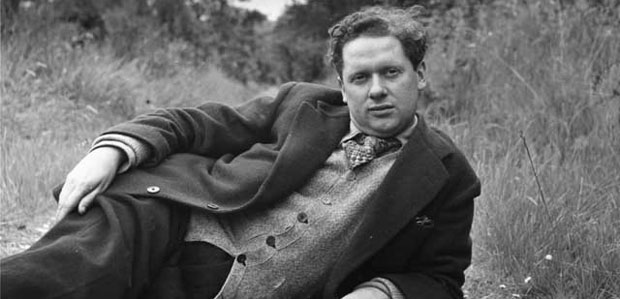
Dylan Thomas

Dylan Thomas Photo

Dylan Thomas was inspired by Mother Goose poems to start writing poetry. Though he couldn’t read then because he was too young to do so, the musical flow of ‘words’ mesmerized him. He could feel the words and that’s probably what made him begin to appreciate poetry.

Sickly Dylan Thomas, of affluent means, did not go to school because the asthma that he suffered from prevented him from taking part in active activities in school. He preferred to stay home and read; and be cosseted, pampered and indulged. When he did finally go to school, it was the ‘friendly neighborhood school’ type of institution where the group was small and the students treated with kindness and gentleness. When World War II rolled round, he was considered too frail to be recruited and was placed in the C-3 category. Individuals in that category would only be called up ‘if and when required’; meaning if there were to occur a shortage of able-bodied men. Thomas therefore served the cause by writing scripts for the government for radio plays and films that were made to boost morale.

Thomas was an unremarkable student, even though he managed to have his first poem published in the school magazine. Similarly, his career too remained undistinguished. He became a journalist, couldn’t handle the pressure and resigned. He spent his time going to the cinema, visiting pubs and generally indulging himself. He contributed to newspapers and publications as a freelance writer and poet, but nothing remarkable emerged from his work. Visiting pubs turned him into a drunkard and finally into an alcoholic and surprisingly, he was rather proud of this habit he had acquired and nursed to perfection. He finally died dead drunk, sinking into an alcohol induced coma frm which he never woke.

In later years, in 1934 to be more precise, Thomas’ work was printed in the Listener. It caught the attention of the famous poets of the time, T.S. Elliott and Stephen Spender. Thomas had finally been recognized and acknowledged, much to his joy. Modernism espoused a ‘choppy’ verse style; many grew fed up with it because it did not conjure up fascinating visual images. By contrast, Dylan Thomas’ work was passionate; it was lyrical and melodious and most of all, his verse was lyrical. Thomas himself was his own greatest promoter, because he recited his work with such a sonorous style that it moved the audience no end. That too contributed to the beauty of his work.

Aside from poetry, his most well-known work is the play ‘Under Milkwood’. BBC commissioned him to write the play for the radio, and was determined to have it done. To ensure the completion of the project, they put their producer Stella Hillier in charge of him to get the work done. Hillier often had to virtually physically drag him out of the pubs and into her office and set him to work. Despite that, the play was many years in the writing. The play was finally completed in 1953, when he went to the USA. He died before the play could be recorded. But when it was recorded, the talented Richard Burton played the lead role. Sometime later the play was adapted for the cinema. And this time, Elizabeth Taylor too joined the cast.

Dylan Thomas will always be remembered for his verse form which is well-ordered and patterned. In this he is highly influenced by biology because he felt biology displayed ‘…unity in diversity…’ in the cycle of life. His work is also influenced by Welsh folklore, Biblical tales and by Freud. His poem, Fern Hill, is probably the most lyrical of his works, while Do not go gentle into that good night, that he wrote on the passing away of his father, is probably the most poignant. His work Deaths and Entrances, capitulated him into the world of recognized poets of his time.

Buy Books by Dylan Thomas

Google
Custom Search

Famous Authors

  • John Updike
  • Jonathan Safran Foer
  • Jonathan Swift
  • Jorge Luis Borges
  • José Saramago
  • Joseph Conrad
  • Joseph Heller
  • Jostein Gaarder
  • Joyce Carol Oates
  • Juan Rulfo
  • Jules Verne
  • Julian Barnes
  • Karl May
  • Kazuo Ishiguro
  • Ken Follett
  • Khaled Hosseini
  • Khalil Gibran
  • Knut Hamsun
  • Kurt Vonnegut
  • Laura Ingalls Wilder
  • Lee Child
  • Leo Tolstoy
  • Lewis Carroll
  • Lord Byron
  • Louise Hay
  • Malcolm Gladwell
  • Marcel Proust
  • Margaret Mitchell
  • Margaret Peterson Haddix
  • Marguerite Yourcenar
  • Mario Puzo
  • Mario Vargas Llosa
  • Mark Twain
  • Martin Amis
  • Mary Higgins Clark
  • Mary Shelley
  • Maurice Sendak
  • Maya Angelou
  • Michael Crichton
  • Michel De Montaigne
  • Michel Houellebecq
  • Miguel De Cervantes
  • Mitch Albom
  • Napoleon Hill
  • Neil Gaiman
  • Niall Ferguson
  • Nicholas Sparks
  • Nick Hornby
  • Nicole Krauss
  • Nora Roberts
  • Norman Mailer
  • Oscar Wilde
  • Ovid
  • P. D. James
  • Patricia Cornwell
  • Paul Auster
  • Paul Celan
  • Paul Valéry
  • Paulo Coelho
  • Peter Hitchens
  • Philip Pullman
  • Pierre Dukan
  • R. L. Stine
  • Ralph Ellison
  • Raymond Carver
  • Raymond Chandler
  • Raymond E. Feist
  • Rhonda Byrne
  • Richard Bach
  • Richard Scarry
  • Richard Wright
  • Rick Riordan
  • Rick Warren
  • Roald Dahl
  • Robert Jordan
  • Robert Louis Stevenson
  • Robert Ludlum
  • Robert Munsch
  • Robin Cook
  • Roger Hargreaves
  • Rudyard Kipling
  • Rumi
  • S. E. Hinton
  • Salman Rushdie
  • Samuel Beckett
  • Samuel Johnson
  • Seamus Heaney
  • Shaun Tan
  • Sidney Sheldon
  • Simone de Beauvoir
  • Sophocles
  • Stendhal
  • Stephen Hawking
  • Stephen King
  • Stephenie Meyer
  • Stieg Larsson
  • Suzanne Collins
  • Sylvia Plath
  • Ted Hughes
  • Tennessee Williams
  • Terry Brooks
  • Terry Pratchett
  • Thomas Mann
  • Thomas Pynchon
  • Tom Clancy
  • Tom Robbins
  • Toni Morrison
  • Truman Capote
  • Umberto Eco
  • Viktor Frankl
  • Virgil
  • Virginia Woolf
  • Vladimir Nabokov
  • Walt Whitman
  • Wilbur Smith
  • William Blake
  • William Faulkner
  • William Gibson
  • William Golding
  • William S. Burroughs
  • William Shakespeare
  • Zora Neale Hurston

Famous Authors

  • Agatha Christie
  • Alan Moore
  • Albert Camus
  • Aldous Huxley
  • Alexander Mccall Smith
  • Allen Ginsberg
  • Anaïs Nin
  • Anne Frank
  • Anne Rice
  • Antoine De Saint-Exupéry
  • Anton Chekhov
  • Arthur C. Clarke
  • Arthur Miller
  • Arundhati Roy
  • Astrid Lindgren
  • Ayn Rand
  • Barbara Cartland
  • Beatrix Potter
  • Beverly Cleary
  • Brian Jacques
  • C. S. Lewis
  • Carol Ann Duffy
  • Charles Dickens
  • Chinua Achebe
  • Christopher Hitchens
  • Christopher Marlowe
  • Christopher Paolini
  • Chuck Palahniuk
  • Clive Cussler
  • Cometan
  • Cormac McCarthy
  • Czesław Miłosz
  • D.H. Lawrence
  • Dale Carnegie
  • Dan Brown
  • Danielle Steel
  • Dante Alighieri
  • Daphne du Maurier
  • Dashiell Hammett
  • Dav Pilkey
  • David Baldacci
  • David Foster Wallace
  • David Sedaris
  • Dean Koontz
  • Debbie Macomber
  • Denis Diderot
  • Don DeLillo
  • Doris Lessing
  • Douglas Adams
  • Dr. Seuss
  • E.M. Forster
  • Edgar Allan Poe
  • Edith Wharton
  • Elbert Hubbard
  • Elie Wiesel
  • Ellen G. White
  • Émile Zola
  • Emily Dickinson
  • Enid Blyton
  • Eoin Colfer
  • Eric Carle
  • Erica Jong
  • Ernest Hemingway
  • Euripides
  • F. Scott Fitzgerald
  • Fernando Pessoa
  • Frank McCourt
  • Flannery O’Connor
  • Franz Kafka
  • Gabriel García Márquez
  • Geoffrey Chaucer
  • George Bernard Shaw
  • George Eliot
  • George Orwell
  • George R. R. Martin
  • Germaine Greer
  • Gertrude Stein
  • Giacomo Leopardi
  • Giovanni Boccaccio
  • Günter Grass
  • Gustave Flaubert
  • H. G. Wells
  • Hans Christian Andersen
  • Harper Lee
  • Haruki Murakami
  • Henning Mankell
  • Henrik Ibsen
  • Henry David Thoreau
  • Henry James
  • Henry Miller
  • Herman Melville
  • Hermann Hesse
  • Homer
  • Honoré De Balzac
  • Hunter S. Thompson
  • Ian Fleming
  • Ian McEwan
  • Isaac Asimov
  • Isabel Allende
  • Italo Calvino
  • Italo Svevo
  • J. G. Ballard
  • J. K. Rowling
  • J. R. R. Tolkien
  • J.D. Salinger
  • Jack Kerouac
  • Jack London
  • Jackie Collins
  • Jacqueline Wilson
  • James Frey
  • James Joyce
  • James Patterson
  • Jane Austen
  • Jean M. Auel
  • Jeff Kinney
  • Jeffrey Archer
  • Jo Nesbø
  • Johann Wolfgang Von Goethe
  • John Gray
  • John Grisham
  • John Irving
  • John Keats
  • John Milton
  • John Steinbeck

Recent Posts

  • 10 Famous Russian Authors You Must Read
  • 10 Famous Indian Authors You Must Read
  • 10 Famous Canadian Authors You Must Read
  • Top 10 Christian Authors You Must Read
  • 10 Best Graphic Novels Of All Time
  • 10 Best Adult Coloring Books Of All Time
  • 10 Best Adventure Books of All Time

Cont.

  • 10 Best Mystery Books of All Time
  • 10 Best Science Fiction Books Of All Time
  • 12 Best Nonfiction Books of All Times
  • Top 10 Greatest Romance Authors of All Time
  • 10 Famous Science Fiction Authors You Must Be Reading
  • Top 10 Famous Romance Novels of All Time

Cont.

  • 10 Famous Science Fiction Authors You Must Be Reading
  • Top 10 Famous Romance Novels of All Time
  • 10 Best Children’s Books of All Time
  • 10 Influential Black Authors You Should Read
  • 16 Stimulating WorkPlaces of Famous Authors
  • The Joy of Books

Copyright © 2026 FamousAuthors.org